01
After breakfast this morning, I suddenly started thinking about subscription cancellation.
Cancel before the period ends — nothing to debate there. The experience is clean.
But what about immediate cancel? Up until I finished yesterday's video, my thinking was:
-
Unlimited subscriptions (subscribe to unlock all premium features, like YouTube Premium): immediate cancel means losing all access right away.
-
Quota-based subscriptions (monthly subscription with fixed credits, like a mobile data plan): keep the subscription credits until the current billing period ends.
But even with that design, I still felt it wasn't the best approach. For quota subscriptions, should credits be wiped after an immediate cancel?
-
Wipe them, and the user feels ripped off — they paid, but the credits vanish.
-
Keep them, and the logic breaks — the subscription is gone but credits remain, which feels like a bug.
There's no good answer. So I asked myself: can we just remove immediate cancel altogether?
02
I looked around and realized most SaaS products only offer cancel-at-period-end. And the experience is actually better for it.
Not supporting immediate cancel isn't laziness or cutting corners — it's a deliberate decision made after thinking it through.
First, immediate cancel doesn't benefit the user.
The user already paid for this month. Immediate cancel means they lose the remaining days of access with zero compensation. That's not "giving users a choice" — it's hurting them.
Second, immediate cancel drags in the refund problem.
Once you support immediate cancel, users naturally ask: what about the money I already paid?
Now you either refund or you don't — both paths are painful. Refunding means calculating pro-rata amounts, handling annual plans, factoring in discounts. Not refunding makes users even angrier, and they go straight to their credit card company for a chargeback — ten times worse than a refund.
Third, immediate cancel creates a status ambiguity.
After an immediate cancel on a quota subscription, should credits be cleared? Clear them and users feel cheated — they paid, but credits are gone. Keep them and it doesn't make logical sense — the subscription ended but credits live on. This dilemma has no clean answer. Cancel-at-period-end sidesteps the entire problem: credits stay until the period ends, clean and simple.
Payment platforms support immediate cancel, but that doesn't mean you have to offer it.
Immediate cancel's real use case is refunds — refund first, then cancel immediately. That's a separate workflow.
For normal subscription management, cancel-at-period-end is enough. So I changed this in the dashboard. When a user clicks cancel, there's no choice anymore — just a clear prompt:
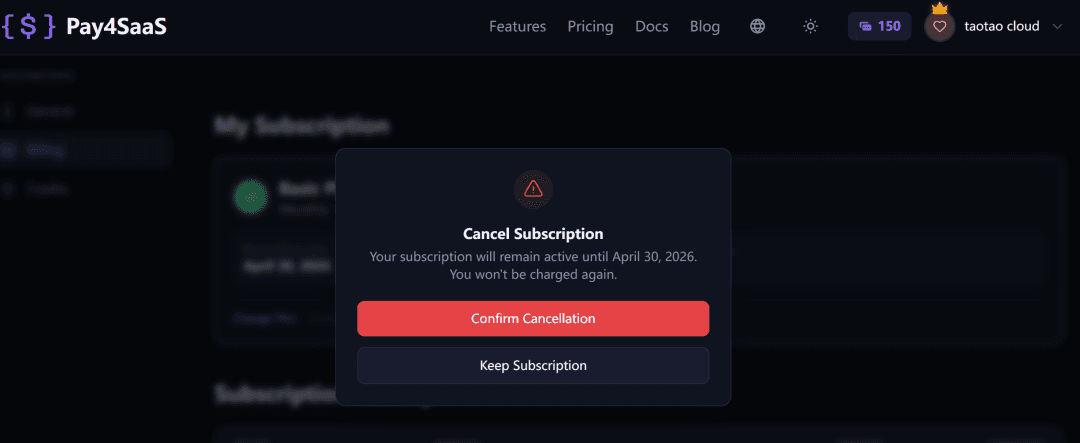
One sentence covers two things: when access ends and that there won't be another charge. The user reads it, knows exactly what's happening, and confirms without hesitation.
Looking back, why did I originally want immediate cancel? Deep down, I was projecting my own distrust of other software onto my product.
I worried users might fear they can't stop charges, that billing would continue. But as you saw in yesterday's video, every step — billing, upgrades, cancellation — was verified against the payment platform. Every safeguard is in place. The first person who needed to feel safe was me.
03
Removing a feature requires more thought than adding one.
Immediate cancel looks like an option, but it bundles refund disputes, credit ambiguity, and user losses into one hidden landmine.
Deliberately removing it after thinking it through isn't laziness — it's killing risk at the design stage.
It's being responsible to your users and to yourself.
As an indie developer, there's no team to fall back on, no customer service to clean up messes. Every decision is yours alone. That's why I'd rather think one step further before shipping.